In today’s digital world, the terms data and information are used everywhere—from business meetings and data science discussions to academic research and everyday decision-making. Although they seem similar, they are fundamentally different in purpose, meaning, and value.
Understanding the difference between data and information is essential for professionals working in business analytics, information technology, healthcare, education, engineering, data science, and even everyday digital communication.
What Is Data?
Professional Definition
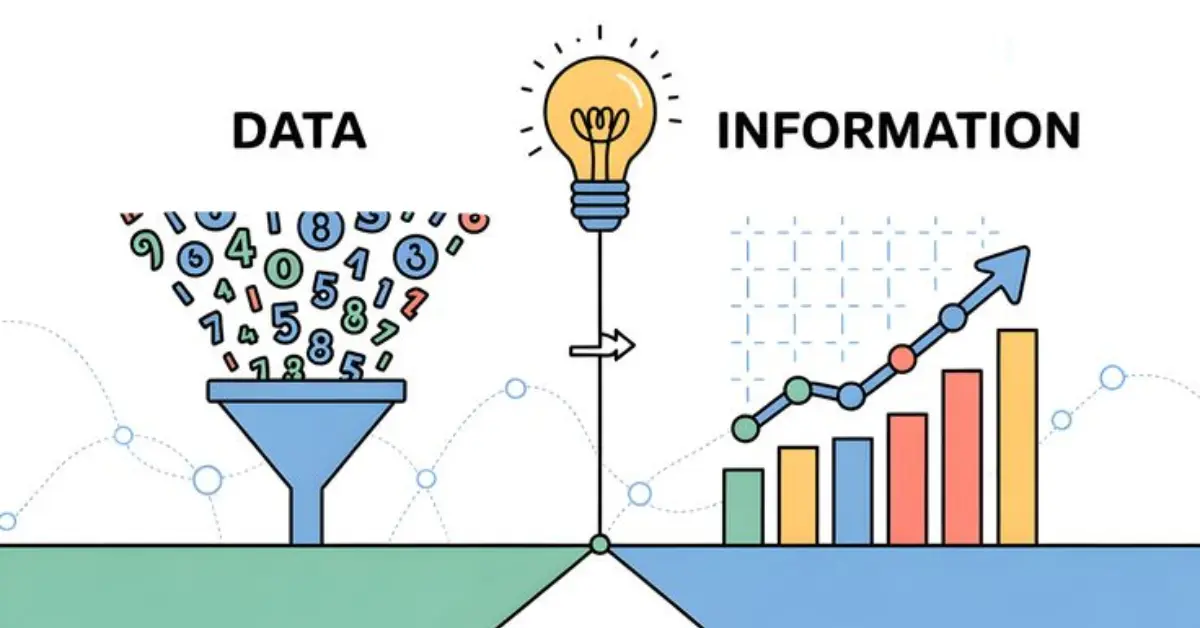
Data refers to raw, unorganized facts, numbers, symbols, or observations collected from various sources.
Data alone does not carry meaning until it is processed or interpreted.
Key Characteristics of Data
- Raw and unorganized
- Context-free (no explanation or interpretation)
- Difficult to understand without analysis
- Collected from multiple sources like sensors, surveys, databases, transactions, and machines
- Cannot directly support decision-making
Also Read: Difference Between Plant and Animal Cell
Examples of Data
- A list of temperatures: 32, 34, 30, 31
- A sequence of dates: 12/02, 13/02, 14/02
- Customer responses: “good,” “satisfied,” “average”
- Machine outputs: 1010 1101 0100
- Student marks: 78, 82, 90, 67
These values exist, but they do not communicate any meaningful insight.
Types of Data
Semantic entities: structured data, unstructured data, qualitative, quantitative, big data.
Quantitative Data (Numerical values)
Example: Income levels, height, speed.
Qualitative Data (Descriptive information)
Example: Colors, categories, opinions.
Structured Data
Arranged in rows and columns, easy to analyze.
Unstructured Data
Images, social media text, audio, video.
What Is Information?
Professional Definition
Information is processed, organized, and meaningful data that provides context and supports understanding or decision-making.
Key Characteristics of Information
- Organized and structured
- Interpreted and contextualized
- Useful for decisions
- Removes uncertainty
- Often presented in reports, summaries, dashboards, graphs, charts, and explanations
Examples of Information
- “The average temperature this week is 32°C, indicating warm weather.”
- “Customer satisfaction increased by 12% this quarter.”
- “Monthly sales declined by 8%, suggesting a need for new marketing strategies.”
These insights help in understanding patterns and making decisions.
Although closely related, data and information serve different purposes in the information lifecycle. Here is a detailed comparison.
Core Difference
| Aspect | Data | Information |
|---|---|---|
| Meaning | Raw facts | Processed facts |
| Nature | Unorganized | Organized |
| Interpretation | No context | Clear context |
| Format | Numbers, symbols, text | Reports, charts, summaries |
| Usefulness | Limited | Highly useful |
| Role | Input | Output |
| Helps Decision-Making | No | Yes |
Understanding Through Real-World Examples
Example 1: Weather
- Data: 34°C, 33°C, 32°C
- Information: “The temperature is gradually decreasing this week.”
Example 2: Education
- Data: Marks of 50 students
- Information: “The class average is 74%, meaning overall performance is good.”
Example 3: Healthcare
- Data: Blood pressure readings
- Information: “The patient has high blood pressure and needs treatment.”
Example 4: Business
- Data: Daily sales numbers
- Information: “Sales increased by 15% due to a seasonal demand spike.”
Example 5: Technology
- Data: System logs
- Information: “Server response time increased due to network congestion.”
How Data Turns Into Information
The Transformation Process
Data becomes information through a structured cycle:
- Data Collection
(Databases, sensors, surveys, transactions) - Data Processing
- Sorting
- Cleaning
- Filtering
- Organizing
- Summarizing
- Analyzing
- Information Generation
- Reports
- Dashboards
- Visualizations
- Decisions
The Role of Technology
Tools like databases, spreadsheets, business intelligence software, data analytics tools, AI systems, and information systems help convert raw data into valuable insights.
Importance of Understanding the Difference
Better Decision-Making
Businesses rely on information—not raw data—to make strategic decisions related to:
- Marketing
- Finance
- Human resources
- Operations
- Customer experience
Reduces Risk
Information helps identify:
- Patterns
- Trends
- Risks
- Weaknesses
- Opportunities
Essential for Data Science and AI
In data science:
- Data is the input to algorithms
- Information becomes insights, predictions, and models
Enhances Communication
Information makes communication clearer, especially in:
- Reports
- Presentations
- Meetings
- Project updates