Cell division is one of the most important processes in biology. It allows living organisms to grow, repair tissues, and reproduce. Two major types of cell division occur in eukaryotic organisms: mitosis and meiosis. Although both involve the splitting of a cell and the duplication of genetic material, they serve very different purposes and follow distinct pathways.
Many students and readers often confuse these two processes because they share similar stages such as prophase, metaphase, anaphase, and telophase. However, understanding the key differences can make the entire subject much clearer.
What Is Mitosis?
Mitosis is a type of cell division that produces two genetically identical daughter cells. These new cells have the same number of chromosomes as the original cell (called the parent cell). In humans, this means each daughter cell has 46 chromosomes.
Purpose of Mitosis
- Growth of tissues and organs
- Repair of damaged cells
- Asexual reproduction in some organisms
- Maintaining chromosome number (diploid → diploid)
Where Mitosis Occurs
Mitosis happens in somatic cells, meaning all body cells except reproductive cells (sperm and egg cells).
Stages of Mitosis
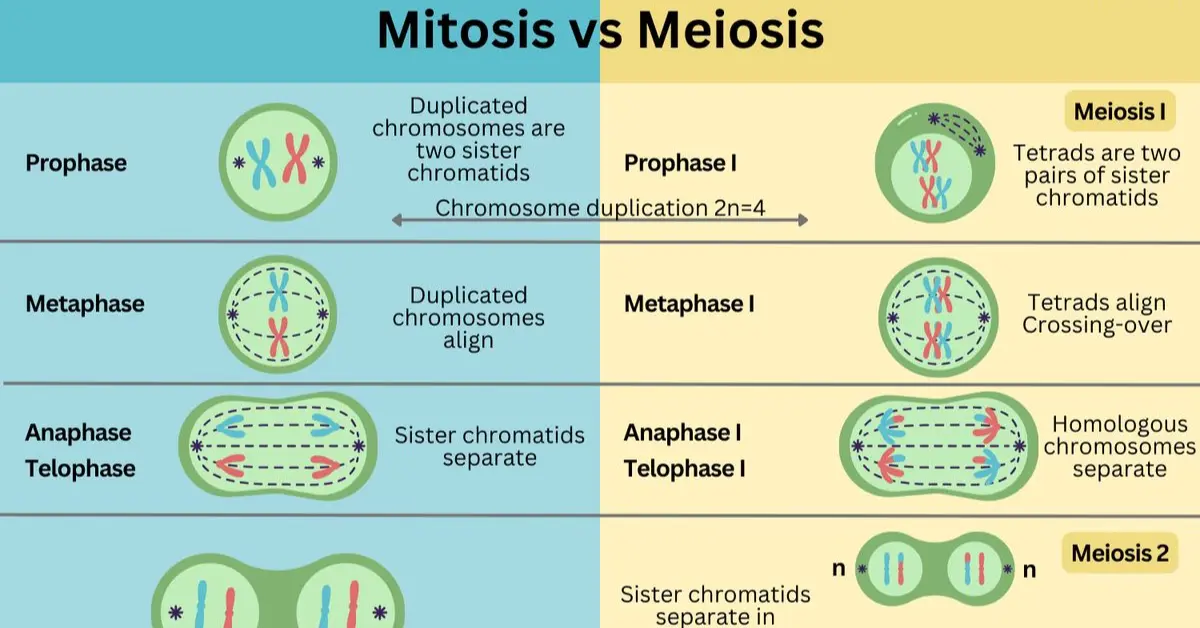
- Prophase – Chromosomes condense; spindle fibers form
- Metaphase – Chromosomes line up in the middle
- Anaphase – Sister chromatids separate
- Telophase – Two nuclei form
- Cytokinesis – Cell splits into two identical cells
Key Features of Mitosis
- One division
- Produces 2 diploid cells
- No crossing-over
- Genetically identical cells
What Is Meiosis?
Meiosis is a type of cell division that produces four genetically different daughter cells. These cells have half the number of chromosomes compared to the original cell.
In humans, meiosis produces gametes:
- Sperm cells (male)
- Egg cells (female)
These gametes contain 23 chromosomes, which makes them haploid. When fertilization occurs, the chromosome number is restored to 46.
Purpose of Meiosis
- Sexual reproduction
- Genetic diversity through recombination and independent assortment
- Reducing chromosome number (diploid → haploid)
Where Meiosis Occurs
Meiosis happens only in germ cells, which are located in the testes (in males) and ovaries (in females).
Stages of Meiosis
Meiosis has two rounds of division:
Meiosis I
- Prophase I – Crossing-over occurs
- Metaphase I – Homologous chromosomes line up
- Anaphase I – Homologous pairs separate
- Telophase I – Two haploid cells form
Meiosis II
- Similar to mitosis
- Sister chromatids separate
- End result: 4 genetically unique haploid cells
Key Features of Meiosis
- Two divisions
- Produces 4 haploid cells
- Crossing-over creates genetic variation
- Cells are genetically different
Key Differences Between Mitosis and Meiosis
Below is a clear comparison summarizing the major differences.
Purpose
- Mitosis: Growth, repair, replace old cells
- Meiosis: Produce gametes for sexual reproduction
Number of Divisions
- Mitosis: One
- Meiosis: Two
Daughter Cells Produced
- Mitosis: 2 identical cells
- Meiosis: 4 unique cells
Genetic Variation
- Mitosis: No variation
- Meiosis: Genetic variation due to crossing-over and independent assortment
Chromosome Number
- Mitosis: Diploid (2n → 2n)
- Meiosis: Haploid (2n → n)
Type of Cells Produced
- Mitosis: Somatic cells
- Meiosis: Sex cells (sperm and eggs)
Location
- Mitosis: Throughout the body
- Meiosis: Ovaries and testes
Why Genetic Variation Matters in Meiosis
One of the most important advantages of meiosis is that it promotes genetic diversity. This happens through:
- Crossing-over (exchange of genetic material)
- Independent assortment (random alignment of chromosomes)
- Random fertilization (sperm + egg combination)
These factors increase variation within a species, helping populations adapt to changing environments.
Why Mitosis Is Essential for Life
Without mitosis:
- We would not grow from a single fertilized egg
- Injuries could not heal
- Old and damaged cells could not be replaced
- Organisms that reproduce asexually would not survive
Mitosis ensures that the body maintains its structure, function, and stability.
Similarities Between Mitosis and Meiosis (Briefly)
Even though they are different, both processes share similarities:
- Both start with a diploid parent cell
- Both involve DNA replication before division
- Both include the major stages (prophase, metaphase, anaphase, telophase)
- Both rely on spindle fibers to move chromosomes
These similarities explain why beginners sometimes confuse the two processes.
Real-Life Examples
Mitosis Examples
- Healing a cut on your skin
- Growth of bones and muscles
- Replacing red blood cells
Meiosis Examples
- Formation of sperm during puberty
- Production of eggs in the ovaries
- Genetic mixing leading to differences in siblings
Quick Comparison Table: Mitosis vs Meiosis
| Feature | Mitosis | Meiosis |
|---|---|---|
| Number of Divisions | 1 | 2 |
| Daughter Cells | 2 | 4 |
| Genetic Similarity | Identical | Different |
| Chromosome Number | Same as parent (diploid) | Half of parent (haploid) |
| Occurs In | Somatic cells | Germ cells |
| Purpose | Growth, repair | Gamete formation |
| Crossing-Over | No | Yes (Prophase I) |
| Type of Reproduction | Asexual | Sexual |
Conclusion
Understanding the difference between mitosis and meiosis is essential for students, biology learners, and anyone interested in how life works at the cellular level. Mitosis ensures growth and repair by creating identical cells, while meiosis generates genetically diverse gametes that are vital for sexual reproduction.
References (General Science Sources)
- Alberts, B. Molecular Biology of the Cell. Garland Science.
- Campbell, N. A., & Reece, J. B. Biology. Pearson Education.
- Lodish, H. Molecular Cell Biology. W.H. Freeman.
- Khan Academy – Cell Division Resources.
- National Center for Biotechnology Information (NCBI).